
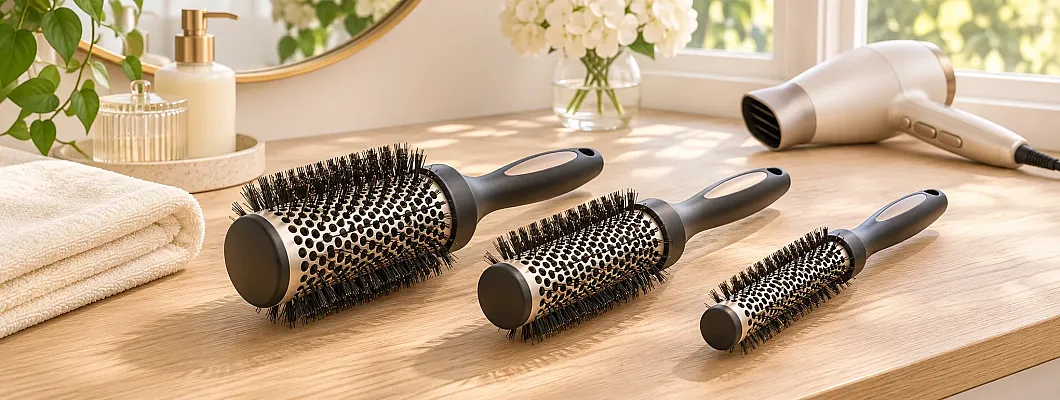
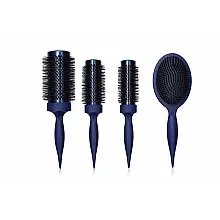
An illustrative atmospheric image created with AI; It is not a product photo.
On the plus side, the brush determines not only how smooth the hair will be, but also where the volume will begin and how the ends will settle. A small diameter gives a pronounced bend and more precise work; A large diameter creates open, wide movement. Bolly Jon brushes in diameters of 33, 43, and 53 mm allow you to choose the way you work according to the length of the hair and the result you want to achieve.
33 mm — Controls short and medium hair and accentuates the bend at the ends
The smallest diameter in the series is suitable for working on short to medium hair, graduated layers, and hair groups that require precision. It allows you to shape the ends without gathering too much of the hair. In a bob haircut, for example, you can work on each group separately and direct the ends inward to get a rounded line, or outward to get an open extension.
For straight hair that tends to sit close to the head, the brush can be used to lift clumps at the crown and shape movement in the upper layers. The work begins in the direction in which the hair is lifted from the root; Diameter alone does not create volume. If you pull the group downward throughout the drying process, you get a flatter finish even with a small brush.
For bangs and face-framing layers, 33mm allows for focused work, provided the hair is long enough to move comfortably around the brush. A smaller diameter may be appropriate for very short bangs. With long hair, this size is used mainly when looking for a noticeable bend at the ends or defined movement in a specific area, and less so when the goal of the work is to smooth the entire length with minimal curl.
Bolly Jon 33mm diameter blow-dry brush Suitable for those who prefer to work in small groups and shape the haircut, especially around the bangs, layers and ends.
43 mm — Smooth glide with natural volume
43 mm is a useful size for medium to long hair, when you're looking for a look that looks neat but not stiff. It allows you to smooth the lengths and leave a soft circle at the ends, instead of a sharp bend. This is a suitable direction for long bobs, shoulder-length hair, and layered haircuts where you want to highlight the movement of the layers.
For a smooth finish, move the brush along the group while maintaining a firm grip on the hair, and twist slightly only towards the ends. For a softer, more wavy result, let the tip follow the curve of the brush. The difference lies in the direction of movement and the degree of rotation, not just in the choice of brush. There is no need to roll the entire length of hair around the body to shape the ends.
In wavy hair, this size can be used to smooth the wave while maintaining movement at the ends. For fine, straight hair, it is suitable for soft styling when there is enough length to work around the brush. With thick hair, work in smaller groups so that the air reaches the hair on the inside of the group as well, and not just the outer layer.
If the goal is an everyday look with a little volume and neat edges, Bolly Jon brush, diameter 43 mm It is a good starting point for comparison. For extra short layers, you can combine a smaller brush with it.
53 mm — Straightening long hair and large, open movement
The large diameter in the series is primarily designed for working on lengths: long hair, long layers, and ends that you want to gently round. Instead of getting a tight bend, you get the option to create a wide arc. This is the direction for a smooth, flowing look with movement at the ends, or for a soft, voluminous look where the hair remains open and airy.
With long, thick hair, the wide brush can be convenient for working on the lengths, but there's no need to load it with a large group. Neat distribution is still more important than brush size: too thick a group makes it difficult to control and dry evenly. It is better to progress in several comfortable groups than to repeat one large group over and over again.
Even long, thin hair can work well with 53 mm, especially when the goal is a soft finish with a bit of roundness. For short hair, short bangs, or a bold bend design, the large brush is less focused. The choice is made according to the desired length and shape, not according to the simple rule that thick hair always needs a large brush.
Bolly Jon brush, diameter 53 mm It is the option to try when the main part of your work is smoothing lengths and creating a wide extension, rather than styling short areas.
How do you adapt the work to thin, thick or curly hair?
Thin and fine hair
The goal is to create a shape without applying unnecessary force. Choose a diameter according to the length: 33 mm for focused work on short layers, 43 mm for soft movement on medium length, and 53 mm for a wide finish on long hair. Gently lift the group when you want volume, and maintain continuous movement of the brush and dryer. The type of fiber and the comfort of the grip are also important; Smaller diameter is not necessarily finer.
Thick or dense hair
Here, dividing the hair is a central part of the work. Separate the areas that are not currently being designed, and work on a group that can be easily held and directed. For long hair, you can choose 43 or 53 mm depending on the desired degree of roundness at the end; In a shorter area, you can go down to 33 mm. Hair density is not a reason to work at higher heat or pull harder.
Wavy or curly hair that you want to smooth out
Start with hair that has been gently untangled, and divide into neat groups. Choose the diameter according to the length and the result: a smaller diameter for shaping a short area or for a bold bend, and a wider diameter for smoothing lengths and open movement. The type of fiber, the grip on the hair, and the technique affect the result alongside the diameter. For those who want to maintain the natural curl structure, this is a different design goal than the smooth aspect described here.
Three things that affect your face more than changing your brush
The size of the hair group. The group should sit on the brush without spreading out to the sides and without making movement difficult. When the brush gets stuck or the hair escapes from it, it is worth stopping and arranging a smaller group. Do not try to overcome entanglement with strong pulling or more heat.
Direction of work. To lift the roots, direct the group upwards; To smooth the lengths, move the brush towards the ends. To round inward or outward, change the direction of rotation at the tip. This way you can get several extensions from the same brush, without having to change tools at each stage.
The ending. After giving the group the desired shape, you can use cold air if the dryer has such an option, and then gently release the hair. Throughout the work, follow the instructions for the brush and dryer, keep the dryer moving and do not press it against the hair or scalp. There is no single temperature that is suitable for all hair types.
One brush or two complementary sizes?
For hair of uniform length and permanent styling, one brush can be enough. In a layered haircut, or long hair with bangs, two sizes may make the job more comfortable: a small brush for the short areas and a wide brush for the lengths. The combination was chosen based on the hairstyle, and not out of a need to buy the entire series.
Those who use multiple sizes can also refer toBolly Jon's Professional Ceramic Brush Set. Before choosing, check the actual contents and dimensions on the set page; Don't assume they are the same as the three individual brushes in the guide.
For a focused selection: Start with33 mm If the main focus of the work is on short hair, layers and a bold edge design; Compare to43 mm If you want smooth gliding; and check the 53 mm If you mainly style long hair and prefer a wide extension. The exact fit also depends on your hair structure and your comfort level.
Leave a comment on the article